Economic problems seem to be to blame in The Witch of Edmonton. The play suggests that it is the poverty of Elizabeth Sawyer that makes people first accuse her of being a witch. I just finished reading A Connecticut Yankee in King Arthur's Court and in this book there is an example that I think applies to Elizabeth. A young woman is about to be hanged because she stole a piece of cloth to sell for food. The priest at the execution makes a speech saying that yes the woman is guilty, but that she would not have stolen anything if it hadn't been for her poverty, which was a direct result of the unfair laws. I think that this can apply to Elizabeth because she is living in poverty probably because she is a widow and has no way of making a living for herself. Women were almost completely helpless in this time period if they were not married or still living in their father's household. I can feel sorry for Elizabeth because it seems like she might have been driven into being a witch because of her economic situation. And then there is Frank; he uses his financial situation as an excuse to marry two women. While I can see how Elizabeth might have a case with the economic situation, Frank is not taking responsibility for his actions. He also says that "To please a father I have heaven displeased" (Act 4, scene 2, line 102). This is his way of rationalizing why he killed Susan, but he is just using his father as a scapegoat. Frank did married Susan because he wanted a better relationship with his father, yet his underlying reason was so that he would not be cut-off financially. Frank is a character that gets forgiven even though no one forced him to do anything, while Elizabeth is labeled a witch mostly because of her economic situation.
I know that I titled this entry 'Economy and Responsibility", but I am going to talk about other things now. I find it interesting that there are so many parallels to Dr. Faustus in this play. The dog come to Elizabeth right after she has cursed Old Banks and Metastophilis comes to Faustus while he is also cursing. The belief back then was that the devil had greater access to you because of what you said. This was used as a warning to keep people from speaking badly and because they really did believe the devil could come to them. Another parallel is on the stage directions on page 163; "sucks her arm, thunder and lighting". The dog has just sucked blood from her arm and then there is thunder and lighting, which I think symbolizes that nature is against the union. Nature does not want her to fall into such evil and is trying to warn her against going ahead with the partnership. The same thing happens to Dr. Faustus when he is trying to seal the deal with Metastophilis in his blood. His blood clots, which is a warning from nature that he is making an evil deal and should not go on. Both he and Elizabeth do not listen to nature and end up being damned to hell becuase of it. There is one more similiarity that I find interesting; the dog and Metastophilis both say they are the servants to Faustus and Elizabeth, but they do not do most of the things asked of them. The biggest reason that they cannot do all that is asked of them seems to be that it is out of their power, that the request goes over into what God controls. Even though there evil servants say they have a lot of power, they actually only have limited power. Elizabeth and Faustus cannot see this and so they think that now they have unlimited power, although they have less power than their servants.
One last thing about Elizabeth - the real reason I think she was hanged. On page 187 she gets into an argument with the Justice, who had just been defending her. The Justice said that the men needed to get better proof id they were going to accuse Elizabeth of being a witch, and then she goes and is disrespectful. She calls out all the hiprocracy in the society and acts like she did not need the Justice's help. This highly offended the Justice who then puts her in jail. I think that if she had been more respectful and thanked him for his help things might have turned out differently. It is obvious that the Justice was skepetical of witches because he wanted better proof, but Elizabeth's reaction was what got her hanged.
I really enjoyed this play. There were many different sub-plots and I think that by having more than one story it made the play more interesting. The reader can compare the different stories and see how they relate to each other in the entire context of the play.
Friday, December 5, 2008

Thursday, December 4, 2008
Familiar Woodcut
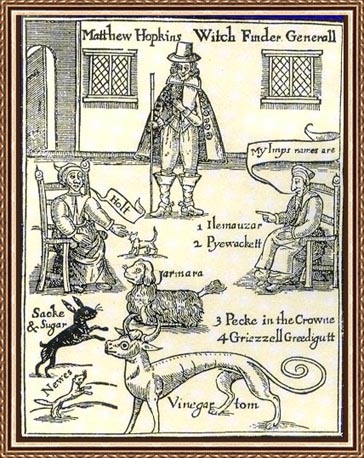 This is a woodcut from around 1647 depicting the familiars of Elizabeth Clark. There are five familiars; a cat, two dogs, a polecat, and a rabbit. Familiars are the “historically, low-ranking demons in constant attention to witches for the purpose of carrying out spells and bewitchment's” (Guiley). They are the ones who usually do the physical harm to the person being cursed. The witch would feed them blood, usually from a third 'teat'. This symbolizes the physical bond that the witch has with her familiars.
At the top of this woodcut is Matthew Hopkins, the most famous English witch-hunter. I find it interesting that he is in the woodcut with the familiars because it shows that the familiars must have come to Elizabeth even after she was accused of being a witch. I would think that the familiars would stay away from her while Hopkins was there, because they would be strong proof that she was a witch. If she was found guilty of witchcraft the familiars would have to find another person, usually a woman, to be their sponsoring witch.
In this woodcut Elizabeth also names all of her familiars. The little dog's name is Jamara, the large dog is Vinegar Tom, the cat is Holt, the polecat is Newes, and the rabbit is Sack and Sugar. I find these to be interesting names because they don't all seem to have anything to do directly with witchcraft. I do not know what Jamara means, but I reminds me of Jamaica and the superstitions that the country holds. I know that Jamacia wasn't an influence on early modern England, but I still find it interesting that the two seem to be connected through witchcraft. The other dog's name, Vinegar Tom, seems like it might be a description of the kind of things he does. He, like vinegar, is not sweet but sour. Vinegar Tom would not be appearing to you in order to do something that would benefit you, but something that would sour your life. For the cat, the only thing I can some up with is the Oxford English Dictionary definition of the word; "a place of refuge or abode; a lurking-place; an animal's lair or den". The cat's name might signify the fact that he is hidden to everyone besides the witch and/or is something that will come lurking around your home and cause harm to you and your family. The polecat, Newes, I find strange all round. I have found that a polecat is related to a weasel and that makes the use of polecats a little clearer in connection to witches. Weasels are considered to be sneaky creatures, and since the polecat is related, they also share that stigma. As for his name, Newes might be for the fact that he brings ill news to the people his master has cursed. There is probably a better explanation, but I cannot think of one. The last familiar in this woodcut is the rabbit; Sack and Sugar. I find it interesting that the name is not 'sack of sugar', although it might just have this curiosity because the English language was different than what it is today. This familiar seems to have a positive connotation as opposed to the negative names of the others. I think this name might be positive because it is positive for the witch. The rabbit helps her do her evil acts and this brings sweetness to the witches life just as sugar sweetens food. Rabbits have been associated with witches for a long time, although today they are basically associated with good magician pulling them out of a hat. I wonder how rabbits became part of the witches association because they do not seem to have anything inherently evil about them. I also find it interesting that the familiars are all named in the woodcut. For some reason I figured that the familiars would not be named because then everyone would know about the familiars and they would somehow not just be the witches 'pets' anymore.
I am also interested in knowing why there are two women in the woodcut and why there names are Ilemauzar and Pyewackett. From what I have found the familiars belong to Elizabeth Clarke and so I don't understand who these women are. Do they have something to do with Elizabeth, or do the familiars belong to them and not to Elizabeth.
This woodcut inspires many questions about witchcraft in early modern England. Some of the aspects of the woodcut seem to inforce what I have learned about witches, but some of the things leave me with more questions than answers.
Picture:http://images.google.com/imgres?imgurl=http://special.lib.gla.ac.uk/images/exhibitions/damned/dadisc.gif&imgrefurl=http://special.lib.gla.ac.uk/exhibns/damnedart/index.html&usg=__hHYLXA2pdEwsn1eGk0rWDDnQTtI=&h=1077&w=800&sz=376&hl=en&start=6&um=1&tbnid=gGPedMf97AJ06M:&tbnh=150&tbnw=111&prev=/images%3Fq%3Dhopkins%2Bwitch%2Bwoodcut%26um%3D1%26hl%3Den%26rlz%3D1T4DKUS_enUS276US281

Monday, December 1, 2008
The Witch of Edmonton
The play that we are reading now is The Witch of Edmonton. At first I was confused because the witch did not show up until the second act, but I think that they play may have more to do with the atmosphere of the time and how people viewed witches as everyday occurances more than being a play about a witch. Another thing that suprised me was that it reads like a modern play. Some of the other plays we have read are obviously from the Rennassiance, but this play seems like it could have been written not too long ago. In act 3, scene 3 lines 103-104 Old Carter says:
"When I speak I look to be spoken to.
Forgetful slut"
This line seems out of place because Old Carter and Old Thorney have just found Susan dead and Frank tied to a tree. Old Carter was Susan's father, yet he calls her a slut. Maybe it had a different definition back then, but this seems out of character for a grieving father.
The Witch of Edmonton also reminds me of some of the other things we have read in class. In Act 3 when Frank says he will kill Susan, she just accepts it. She seems to be the tragic woman that cannot do anything for herself and will do whatever males tell her. In a way she reminds me of Una from The Faerie Queen. She does not take control of the situation and does not fight anything. She and Una simply let things happen to them and then say "oh well, I cannot do anything about it". I don't really care for Susan's character because she doesn't care about herself. She lets Frank kill her and doesn't do anything to stop him. If she tried to save herself then I would have more respect for her character.
I do feel sorry for Winifride's character. She was more than likely taken advantage of by her master and then her husband marries someone else. In class we talked about her being a victim of her circumstances and I agree with that. She was put in a bad position by her master, who I feel is a creepy older man from what I read in the play. She really couldn't say no because he was her master, but when she actually finds someone she likes he has to keep her a secret. Winnifride loves Frank, but Frank is motivated by money and has to hide their relationship so his father does not cut him off financially. She loves someone who values money more than her, and for that I also feel sorry for her. She does not have many choices because she is a woman in this time period and she does not have any money. I feel that she is a victim of her circumstances and I am interested in knowing what else happens to her charcter.
"When I speak I look to be spoken to.
Forgetful slut"
This line seems out of place because Old Carter and Old Thorney have just found Susan dead and Frank tied to a tree. Old Carter was Susan's father, yet he calls her a slut. Maybe it had a different definition back then, but this seems out of character for a grieving father.
The Witch of Edmonton also reminds me of some of the other things we have read in class. In Act 3 when Frank says he will kill Susan, she just accepts it. She seems to be the tragic woman that cannot do anything for herself and will do whatever males tell her. In a way she reminds me of Una from The Faerie Queen. She does not take control of the situation and does not fight anything. She and Una simply let things happen to them and then say "oh well, I cannot do anything about it". I don't really care for Susan's character because she doesn't care about herself. She lets Frank kill her and doesn't do anything to stop him. If she tried to save herself then I would have more respect for her character.
I do feel sorry for Winifride's character. She was more than likely taken advantage of by her master and then her husband marries someone else. In class we talked about her being a victim of her circumstances and I agree with that. She was put in a bad position by her master, who I feel is a creepy older man from what I read in the play. She really couldn't say no because he was her master, but when she actually finds someone she likes he has to keep her a secret. Winnifride loves Frank, but Frank is motivated by money and has to hide their relationship so his father does not cut him off financially. She loves someone who values money more than her, and for that I also feel sorry for her. She does not have many choices because she is a woman in this time period and she does not have any money. I feel that she is a victim of her circumstances and I am interested in knowing what else happens to her charcter.
Monday, November 17, 2008
Act 4: The Duchess of Malfi
There are some things in Act 4 that I find strange. One is Bosola. In Act 1 Scene 2 Bolosa is handed money and his reaction is "Whose throat must I cut" (line 155), yet in Act 4 he seems to have done a 180. He says in Scene 1, "Come, be of comfort. I will save your life" and "Now, by my life, I pity you". At the beginning of the play he was willing to kill anyone and do anything, and now he seems to be regretting his part in the Duchess's downfall. I think that Bosola never had to face the consequences of his actions because his actions were mostly to kill for the powerful. By killing for the powerful he never got into trouble and he did not have to see how others were affected by his actions. Because he did not kill the Duchess or her family, but simply helped to bring their downfall, he has to watch them suffer.
Act 4, Scene 1
(131) Bosola - Must I see her again?
Ferdinand - Yes
Bosola - Never
Ferdinand - You must
Bosola - Never in mine own shape
That's forfeited by my intelligence
And this last cruel lie. When you send me next,
The business shall be comfort.
Although Bosola does not want to see the Duchess and the misery he has caused her, he does not seem to have totally repented from his evil ways. He argues with Ferdinand and tells him he will never again see the Duchess, yet he says that the next job he goes on "shall be comfort". Bosola does not want to stop working for Ferdinand, he only wants to not have to see the consequences of his actions again.
Bosola then appears again in scene 2 and is the one who come to tell the Duchess she is going to die. He says "I am come to make thy tomb" (line 104) and the Duchess asks if he is mad. Bosola does seem for a while to have gone mad, which could be a reflection of the fact that Ferdinand, the man he works for, does seem to go mad in Act 5. But later on in the scene he seems fine, so I am not sure what to make of it. And it seems strange to me that in scene 1 Bosola does not want anything more to do with the Duchess, yet he is the one who brings the executioners and tells her it is time to die. The Duchess does not seem to be afraid of death, in fact she says "Who would be afraid on 't" (line 189). Even though she does not fear death, I don;'t understand Bosola's reason for being there. One way that I can rationalize him being there is because he is the one who likes to kill people. That is what he is paid to do and that way he does not have to deal with the person's suffering because the person is dead. I think that maybe be enjoys being the evil one as long as he does not have to realize people suffer. And I know that he must on some level know that people suffer when they are killed because they want to live, but their suffering is short-lived and that I think makes all the difference. Once Bosola does what he is paid to do the person is not suffering anymore. Except in the case of the Duchess, which I talked about in the paragraph or two above, all his victims were killed. I think that with the Duchess he realizes that making people suffer for long periods of time is evil, yet I think that he does not sense that killing people is just as bad.
There is one thing that I don't quite understand about Act 4. In scene 2 the Duchess and her children are murdered, yet you only find out because of side notes to the actors. The words of the play give no indication that anyone has been killed and apparently expects the audience to see the actors being killed, which is something a reader cannot see. I supposed that the reason no one says "And they die" is because it is a play and of course Webster probably intended for his play to be seen and not read. I can see how the play leads up to the Duchess's death, but I don't understand the logic behind her children's deaths. With the Duchess there is dialogue and you realise that the Duchess is not afraid of death, so in a since her death is not so tragic. But the children's death seems to be a forgotten side not; like Webster was said "oops, I forgot about the kids, well I guess they better go to" (although I'm sure he would not have used those words because they sound evil). One explanation for the children's deaths being simply a side note is because Webster did not want the play to have more tragedy than it already did. If he was to put in a scene with the children's murder then the audience might have been stuck more on that scene than Webster wanted them to be. The death of children would stand out more and might overshadow the parts of the play that Webster wanted to really focus on. Although I think he could have done something more than give the children's death only a side note.
Act 4, Scene 1
(131) Bosola - Must I see her again?
Ferdinand - Yes
Bosola - Never
Ferdinand - You must
Bosola - Never in mine own shape
That's forfeited by my intelligence
And this last cruel lie. When you send me next,
The business shall be comfort.
Although Bosola does not want to see the Duchess and the misery he has caused her, he does not seem to have totally repented from his evil ways. He argues with Ferdinand and tells him he will never again see the Duchess, yet he says that the next job he goes on "shall be comfort". Bosola does not want to stop working for Ferdinand, he only wants to not have to see the consequences of his actions again.
Bosola then appears again in scene 2 and is the one who come to tell the Duchess she is going to die. He says "I am come to make thy tomb" (line 104) and the Duchess asks if he is mad. Bosola does seem for a while to have gone mad, which could be a reflection of the fact that Ferdinand, the man he works for, does seem to go mad in Act 5. But later on in the scene he seems fine, so I am not sure what to make of it. And it seems strange to me that in scene 1 Bosola does not want anything more to do with the Duchess, yet he is the one who brings the executioners and tells her it is time to die. The Duchess does not seem to be afraid of death, in fact she says "Who would be afraid on 't" (line 189). Even though she does not fear death, I don;'t understand Bosola's reason for being there. One way that I can rationalize him being there is because he is the one who likes to kill people. That is what he is paid to do and that way he does not have to deal with the person's suffering because the person is dead. I think that maybe be enjoys being the evil one as long as he does not have to realize people suffer. And I know that he must on some level know that people suffer when they are killed because they want to live, but their suffering is short-lived and that I think makes all the difference. Once Bosola does what he is paid to do the person is not suffering anymore. Except in the case of the Duchess, which I talked about in the paragraph or two above, all his victims were killed. I think that with the Duchess he realizes that making people suffer for long periods of time is evil, yet I think that he does not sense that killing people is just as bad.
There is one thing that I don't quite understand about Act 4. In scene 2 the Duchess and her children are murdered, yet you only find out because of side notes to the actors. The words of the play give no indication that anyone has been killed and apparently expects the audience to see the actors being killed, which is something a reader cannot see. I supposed that the reason no one says "And they die" is because it is a play and of course Webster probably intended for his play to be seen and not read. I can see how the play leads up to the Duchess's death, but I don't understand the logic behind her children's deaths. With the Duchess there is dialogue and you realise that the Duchess is not afraid of death, so in a since her death is not so tragic. But the children's death seems to be a forgotten side not; like Webster was said "oops, I forgot about the kids, well I guess they better go to" (although I'm sure he would not have used those words because they sound evil). One explanation for the children's deaths being simply a side note is because Webster did not want the play to have more tragedy than it already did. If he was to put in a scene with the children's murder then the audience might have been stuck more on that scene than Webster wanted them to be. The death of children would stand out more and might overshadow the parts of the play that Webster wanted to really focus on. Although I think he could have done something more than give the children's death only a side note.
Thursday, November 13, 2008
Duchess of Malfi (Part 2)
So I need to come up with more interesting titles for my entries. I will work on that. So far I have read through act 3 of the Duchess of Malfi. I enjoy this play better than I enjoyed Hamlet and I really don't know why. I think it might be because it feels like there is more drama that is real. In Hamlet there was the ghost and his father murder, but those incidents seemed to be farther from reality than the drama in Duchess. The Duchess has to deal with her feelings for someone of a lower class, her brothers not wanting her to re-marry, and her brother Ferdinand's sexual and violent threats. She has a lot to deal with besides trying to rule her dukedom.
Antonio is the man she loves, yet he is her servant. In one scene the Duchess vows that she will never marry and then turns around the marries Antonio. I think that she said she would never marry so that her brothers would leave her alone because they were basically attacking her. I also believe that she had already planned to marry Antonio before she told her brothers she would not marry. I don't think that she would have simply turned to the first man see saw and marry him just to spite her brothers. She seems like a better person than that, although I could see one of her brothers simply marrying someone out of spite. It is obvious that Antonio really does love her, although it takes a while for him to realize that the Duchess is asking him to marry her. Antonio probably thought that his love would never be reciprocated because he is not on the same social level as the Duchess and normally she would not have married into a lower social class. Another reason, besides love, that I think she might have married Antonio is because he would not boss her around as her brothers do. The Duchess seems to be a pretty independent woman who would not like having a man boss her around simply because he was a man. Although I so think she loves Antonio, I also think she loves the thought that he will not try and lord over her.
At the end of the third act the Duchess, Antonio, and there children are banished. As I understand it her brother, the Cardinal, went to the Pope and said that she was living in sin and that the Church should repossess her dukedom for the sake of the people. So the Pope takes away her dukedom and then her brother banishes her from another land. The Duchess then asks Antonio to take their oldest boy and go to Milan separately because she fears that they will be attacked and she doesn't want the entire family to be killed if they are attacked. I think that this shows that the Duchess can think rationally even in times of danger and that she also fears for their lives. Because this play is a tragedy I know that everyone will probably end up dead, yet I feel bad for the Duchess and her family because they know that they will more than likely be killed and that they will be killed by family. The Cardinal and Ferdinand will most likely not kill them themselves, yet they will be behind the murders. The Duchess's brothers are not good people, yet they are also men of power and so they will most likely get away with whatever they do. They seem to parallel to Hamlet's uncle, in that they are supposed to be the men that enforce justice, and because they are supposed to enforce it, they will get away anything they choose to do because no one will challenge them.
There are two more acts in The Duchess of Malfi so I will probably post about them sometime soon. If I don't then I will post about witches in early Modern England because my presentation is coming up and I am starting to research them.
Antonio is the man she loves, yet he is her servant. In one scene the Duchess vows that she will never marry and then turns around the marries Antonio. I think that she said she would never marry so that her brothers would leave her alone because they were basically attacking her. I also believe that she had already planned to marry Antonio before she told her brothers she would not marry. I don't think that she would have simply turned to the first man see saw and marry him just to spite her brothers. She seems like a better person than that, although I could see one of her brothers simply marrying someone out of spite. It is obvious that Antonio really does love her, although it takes a while for him to realize that the Duchess is asking him to marry her. Antonio probably thought that his love would never be reciprocated because he is not on the same social level as the Duchess and normally she would not have married into a lower social class. Another reason, besides love, that I think she might have married Antonio is because he would not boss her around as her brothers do. The Duchess seems to be a pretty independent woman who would not like having a man boss her around simply because he was a man. Although I so think she loves Antonio, I also think she loves the thought that he will not try and lord over her.
At the end of the third act the Duchess, Antonio, and there children are banished. As I understand it her brother, the Cardinal, went to the Pope and said that she was living in sin and that the Church should repossess her dukedom for the sake of the people. So the Pope takes away her dukedom and then her brother banishes her from another land. The Duchess then asks Antonio to take their oldest boy and go to Milan separately because she fears that they will be attacked and she doesn't want the entire family to be killed if they are attacked. I think that this shows that the Duchess can think rationally even in times of danger and that she also fears for their lives. Because this play is a tragedy I know that everyone will probably end up dead, yet I feel bad for the Duchess and her family because they know that they will more than likely be killed and that they will be killed by family. The Cardinal and Ferdinand will most likely not kill them themselves, yet they will be behind the murders. The Duchess's brothers are not good people, yet they are also men of power and so they will most likely get away with whatever they do. They seem to parallel to Hamlet's uncle, in that they are supposed to be the men that enforce justice, and because they are supposed to enforce it, they will get away anything they choose to do because no one will challenge them.
There are two more acts in The Duchess of Malfi so I will probably post about them sometime soon. If I don't then I will post about witches in early Modern England because my presentation is coming up and I am starting to research them.
Monday, November 10, 2008
Witches in Early Modern England
 I am doing my project on witches in Early Modern England. So far I have learned a lot about what the people in Renaissance England actually thought of witches.
 The woodcut to the left is from the sixteen to seventeen hundreds, and while it is not an accurate protrayl of English witches, I thought it was interesting.
Witch hunting started much later in England than it did on continental Europe. I suspect that one reason is because England is an island and the hysteria of witches was not as easily spread over the English Channel. A person accused of being a witch also had an easier time in England than in the rest of Europe. Using torture to get a witch to confess was illegal in England, although milder tortures were often used. And because torture was illegal, it was much harder to get a supposed "witch" to confess. Although torture was not used as often, being accused of witchcraft was still not a good thing.
A couple things were done to try and prove a person was really a witch. One of the most popular tests was whether or not the person had a "witch's mark". This was some sort of skin protrusion or third nipple that the witch would feed its familiars from. A familiar was sort of a demon given to the witch by the devil to do the witches bidding. Most familiars were in the form of household pets (cats, dogs) or common animals (rats, owls, toads). Supposedly the witch would feed her familiar like a mother would feed her children.
Women were also accused of being witched much more often than men were. In England witches had more to do with household occurrences than devil worshiping or flying on brooms. The kind of things that a witch would be blamed for were children and animals falling ill or dying, the chickens not laying eggs, or the butter not churning. These things all have to do with women's roles in the family, and were more likely to be blamed on other women. In England about 90% of accused witches were witches, while in continental Europe around 80% of witches were women. Another thing about witches and women is that mid-wives were not accused of being witches. In fact, mid-wives were often employed as witch-hunters because they knew the majority of women in the community quite well. Since being a mid-wife was the highest profession a women could have, they were respected members of the community and would often search for the "witch's mark" because it was considered more appropriate for a woman to search another woman.
I will continue to post about witches as the semester wraps up.
The Duchess of Malfi

I am now reading "The Duchess of Malfi", which is a play that I find interesting. There are a few things I wonder about though, such as how no one figures out that Antonio married to the Duchess. The Duchess has three children with him, yet only the people they told suspect the relationship. Most people in nobility are watched pretty carefully, yet no one has caught on about the Duchess and Antonio. Then there is the question of why the Duchess is only called the Duchess. She is never given an actual name, which is funny since the play is named after her. One reason she might not have a name is because she is symbolic. The Duchess is a duchess, but she is also a wife and mother. To not give her another name suggests that the duty as duchess comes before her family, which is opposite to how most women feel. Most women put their family first and their work second. By not giving her a name John Webster could be commenting on the fact that women should be mother's and wives, rather than rulers. If this is true then it comes at an interesting time period because it is right after Queen Elizabeth ruled England. Elizabeth never married and ruled without a king for her entire reign as queen. John Webster could be saying that he felt that Elizabeth should have married and let a man take over the country while she raised their family. Because Elizabeth never married and had children, the people worried about who would become the new monarch after Elizabeth died. This anxious feeling would have been around during the time that Webster was growing up, and subsequently it could have affected his views on women as monarchs.
Another thing I find interesting is that the Duchess's brother is a Cardinal. He is another character that is never called by any other name, maybe to emphasize his role as a Cardinal in the Catholic Church. At this period England was lead by the Anglican Church, and Catholicism was strongly discouraged. Even though this play is set in Italy one hundred years ago, I think that Webster's personal views on the Catholic Church are coming through in the Cardinal. He is a character that is evil and does things for the good of himself and not for others. This might be symbolizing the corruption of the Catholic Church and how the priests and other officials were more interested in earthly things than the things of God. I also think it is interesting that supposedly he had a thing for his sister. I read this in the summary before the play starts and have not gotten that far in the play, but I am curious about how Webster is going to portray this relationship.
The issue of twins in the play that I find intriguing. My brothers are twins, so every time I think of twins I think of them. Apparently Ferdinand and the Duchess are twins, yet Ferdinand and the Cardinal are compared to each others as twins. I would think that the Cardinal and the Duchess would be the twins because their names are both titles. Although Ferdinand and the Cardinal are both considered to be on the darker side and to only think about themselves, they don't appear to me to be twin like. To me twins are actually more opposite each other than regular brothers and sisters. The Cardinal and Ferdinand to me would work better as just being the brothers that they are and not compared as twins. The real twins, the Duchess and the Cardinal, seem like the better twins here because they seem like polar opposites. The Duchess cares about her family and her people, while the Cardinal seems to only care about himself. The issue of twins in this time period is also an interesting one because we talked in class about how twins were thought of as good oddities. I might be thinking of an earlier time period in England, but I do find it intriguing that twins were thought of as so interesting.
I am only through two acts of the play, but I will write later on how I feel about the rest of the play.
Another thing I find interesting is that the Duchess's brother is a Cardinal. He is another character that is never called by any other name, maybe to emphasize his role as a Cardinal in the Catholic Church. At this period England was lead by the Anglican Church, and Catholicism was strongly discouraged. Even though this play is set in Italy one hundred years ago, I think that Webster's personal views on the Catholic Church are coming through in the Cardinal. He is a character that is evil and does things for the good of himself and not for others. This might be symbolizing the corruption of the Catholic Church and how the priests and other officials were more interested in earthly things than the things of God. I also think it is interesting that supposedly he had a thing for his sister. I read this in the summary before the play starts and have not gotten that far in the play, but I am curious about how Webster is going to portray this relationship.
The issue of twins in the play that I find intriguing. My brothers are twins, so every time I think of twins I think of them. Apparently Ferdinand and the Duchess are twins, yet Ferdinand and the Cardinal are compared to each others as twins. I would think that the Cardinal and the Duchess would be the twins because their names are both titles. Although Ferdinand and the Cardinal are both considered to be on the darker side and to only think about themselves, they don't appear to me to be twin like. To me twins are actually more opposite each other than regular brothers and sisters. The Cardinal and Ferdinand to me would work better as just being the brothers that they are and not compared as twins. The real twins, the Duchess and the Cardinal, seem like the better twins here because they seem like polar opposites. The Duchess cares about her family and her people, while the Cardinal seems to only care about himself. The issue of twins in this time period is also an interesting one because we talked in class about how twins were thought of as good oddities. I might be thinking of an earlier time period in England, but I do find it intriguing that twins were thought of as so interesting.
I am only through two acts of the play, but I will write later on how I feel about the rest of the play.

Subscribe to:
Posts (Atom)